The record Pharoah Sanders made after Trane
Karma, 1969.
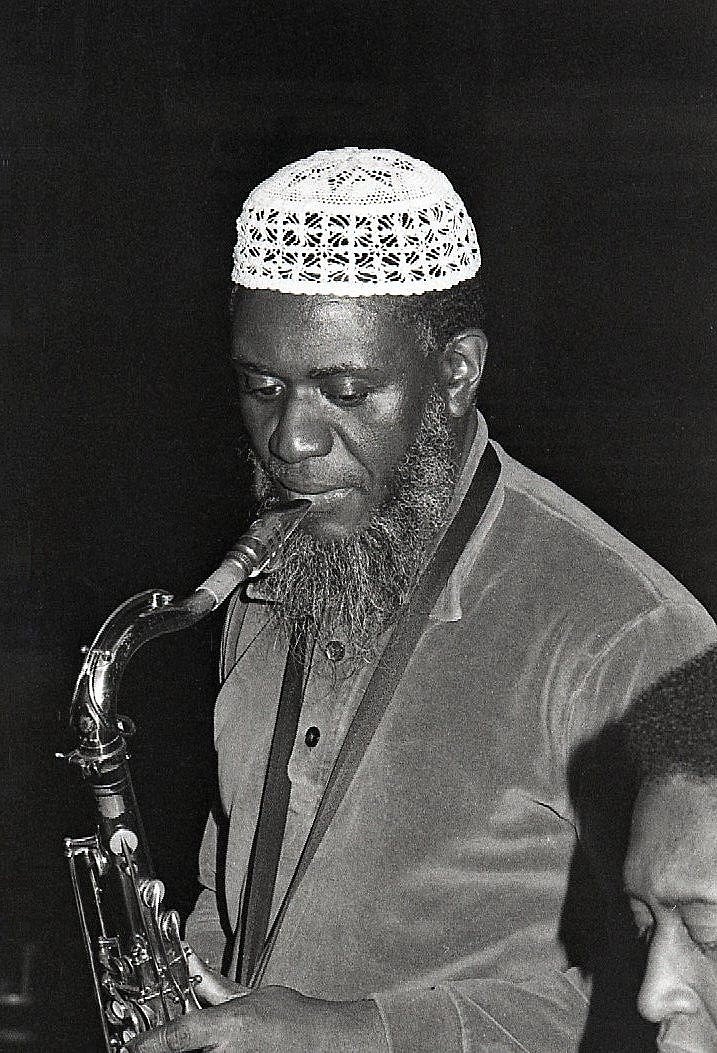
Pharoah Sanders was born Ferrell Lee Sanders in Little Rock, Arkansas, in 1940. His grandmother wanted to name him after the pharaohs in the Bible. He moved to New York in 1962 with more horn than money. For a while he was homeless, and Sun Ra gave him a place to live, clothes, and encouragement to use the name Pharoah.
By 1965 he was in John Coltrane's band, singing and screaming through the tenor at the same time on Ascension and Meditations. Albert Ayler put the pecking order best: "Trane was the Father, Pharoah was the Son, I am the Holy Ghost." When Coltrane died in July 1967, Pharoah was twenty-six years old. Somebody had to carry the fire.
His answer came two winters later. On February 14 and 19, 1969, at RCA Studios in New York, he recorded Karma for Impulse! with producer Bob Thiele. It was his third album as a leader, and he brought a small orchestra: singer Leon Thomas, pianist Lonnie Liston Smith, two bassists, drums, flute, French horn, and percussion.
The heart of the record is "The Creator Has a Master Plan," thirty-three minutes, written with Leon Thomas. It opens like a prayer: a slow bass figure, a melody you can hum after one listen, Thomas singing that there is a plan for us all. Then it breaks open into some of the wildest tenor playing ever put on tape, split reeds and multiphonics, and then the chant comes back, and you realize the storm was holding a song the whole time.

The second track, "Colors," is five quiet minutes, like the morning after the storm. Against all sense for a half-hour free-jazz piece, FM radio played "The Creator." It became about the closest the avant-garde ever came to a hit. Pitchfork later ranked Karma number 53 among the best albums of the 1960s, and the New Yorker put it on its list of essential jazz albums.

The Creator Has a Master Plan (33 minutes)
Listen along
Every track this story mentions, playable right here:

Colors (the quiet second track)

Where it leads: Lonnie Liston Smith, Expansions

Behind this record: John Coltrane, A Love Supreme
Where it leads: the pianist on this record, Lonnie Liston Smith, made Expansions six years later with the same producer. Then go behind this record to John Coltrane's A Love Supreme, the prayer "The Creator" answers. Karma itself is in our free guide.
Heard it? Come talk about it in the listening room.
Get the next Deep Listen first.
New stories go to the email list before they go anywhere else. Free, one a week.